22 June | 7 min read
Software development has continuously evolved with technology because the world around it changes. We have reached the phase now where everything seems robotic, from rigid sequential models to Agile and DevOps; each transformation was driven by the one simple goal of how to deliver better software, faster, in less time. As time changes, the world has adapted to AI efficiency, and GenAI is shaping the next stage of that evolution.
What makes this shift different is its reach. GenAI started as AI-assisted code completion and has quickly emerged into something more powerful today. At present, GenAI generates code, writes documentation, creates test cases, analyzes legacy systems, and even assists in architectural decisions. GenAI is not AI-assisted anymore; it is reshaping how the entire software development life cycle works.
For the technology leaders and decision makers, GenAI is no longer a productivity trend or experiment. It is evolving as a strategic capability that directly affects engineering productivity, operational efficiency, software quality, and delivery speed. Now, the real question is not about whether to adopt it, but how to harness it in a way that strengthens, without compromising security, governance, or engineering quality.
In today’s or most recent workflow, formerly called traditional workflows, your dev team just spent 6 months building a feature that customers don’t want. The business changed priorities halfway through. Testing revealed critical gaps. And now you’re late to market while competitors are already shipping.
Every leader is now asking, What if you could cut development time by 50%, generate test cases in minutes instead of days, and let your best engineers focus on solving real business problems instead of writing boilerplate code?
Here, welcome to GenAI-assisted SDLC – the next evolution of software delivery. The traditional waterfall gave you structure, DevOps really improved the efficiency and speed, Agile brought the flexibility to the development, and now here’s GenAI, which is rewriting the software development rules entirely.
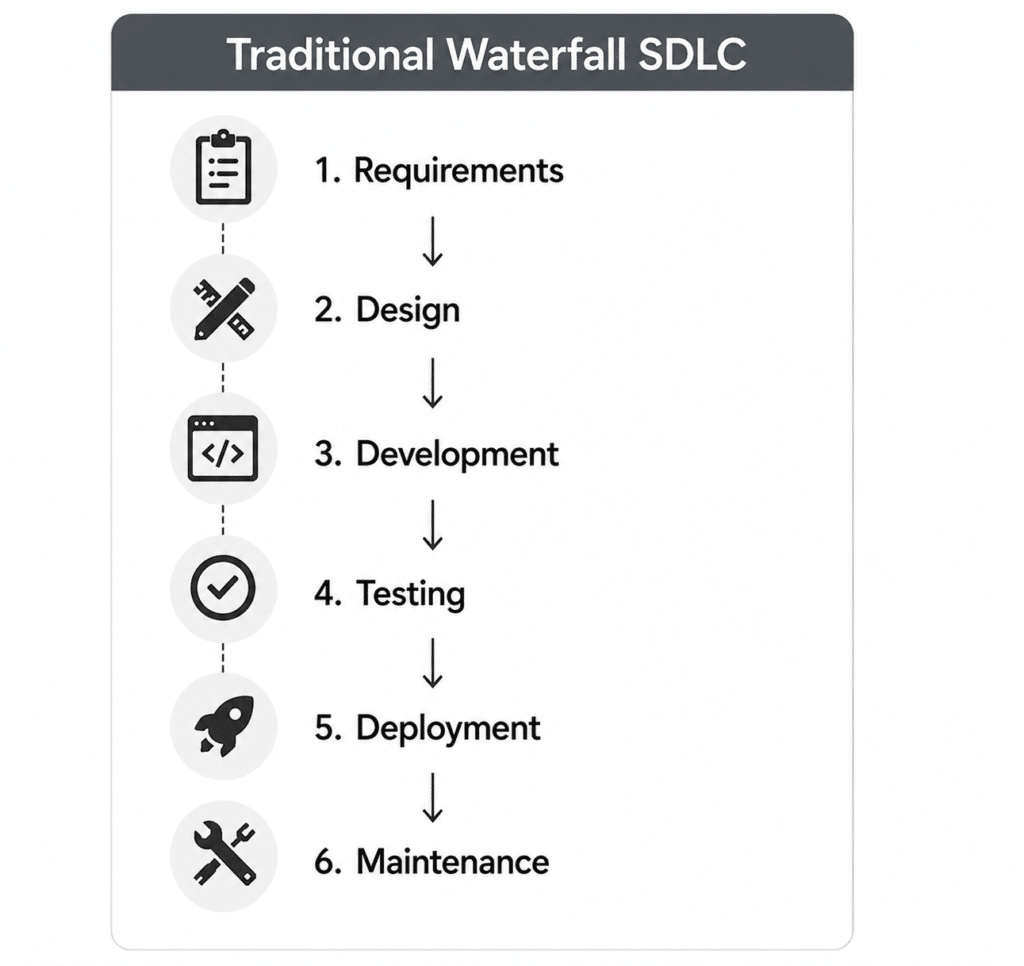
Well, the traditional models, such as Waterfall, were especially designed for predictability & control, and each phase followed a structured sequence.
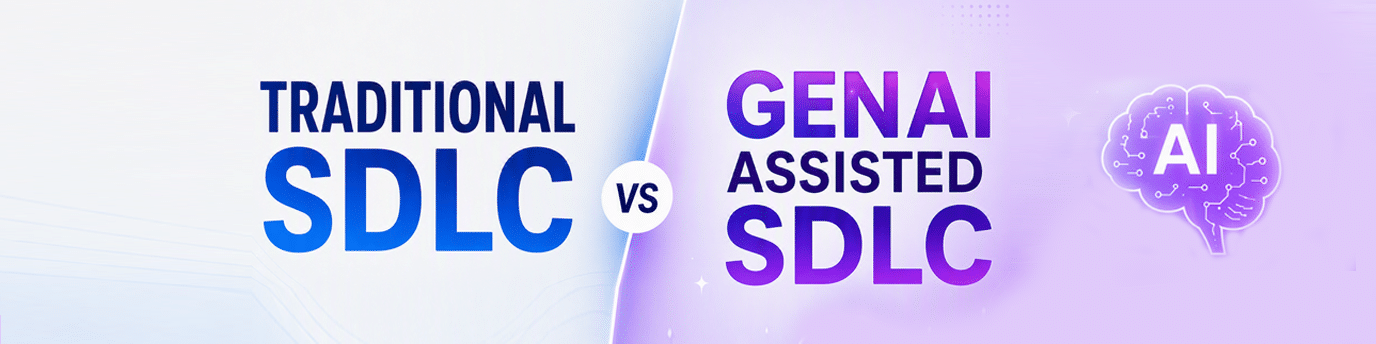
Vs Now (GenA)
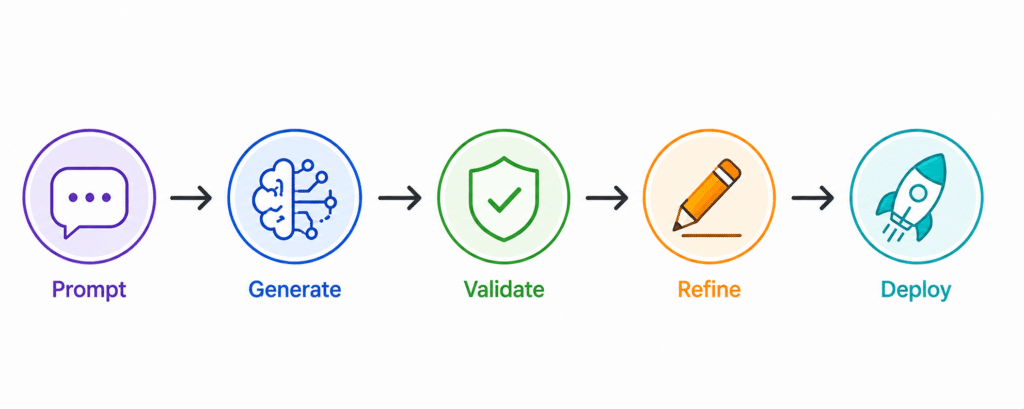
However, this traditional approach worked effectively where requirements were stable. Each stage followed a fixed sequence: requirements, design, development, testing, deployment, and maintenance. Whereas, in modern enterprises, it’s hardly the case that users expect continuous improvement. Business priorities shift more often, and competitive pressure demands faster releases and shorter feedback loops. In this context, a rigid sequential model can become a constraint rather than an advantage.
| Model | Strength | Limitation | Delivery style |
| Waterfall | Predictable and structured | Difficult to adapt to change | Sequential |
| Agile | Flexible and iterative | Can become fragmented without discipline | Incremental |
| DevOps | Faster and better collaboration | Requires strong automation and culture | Continous |
| GenAI | Higher speed and automation | Needs validation and governance | Accelerated |
These challenges eventually led to the rise of Agile and DevOps methodologies, which prioritized collaboration, iteration, and continuous delivery.
But GenAI is accelerating the transformation even further.
| SDLC Phase | Traditional Process | What GenAI Helps with | Business Impact |
| Requirements | Manual documentation and analysis | AI-generated requirement summaries and refinement | Faster analysis |
| Design | Human-driven architecture planning | AI-assisted architecture suggestions and simulations | Better early decisions |
| Development | Fully manual coding | AI-generated code, autocomplete, and refactoring | Higher productivity |
| testing | Manual test case creation | Automated test generation and bug prediction | Better coverage |
| Deployment | Script-based deployment | AI-assisted deployment optimization | Less manual effort |
| maintainence | Reactive issue resolution | Predictive monitoring and intelligent troubleshooting | Faster resolution, reduced downtime, and improved system reliability. |
The shift is significant: software teams are moving from simply writing code to supervising and validating AI-assisted outputs.
What once took days of coding, documentation, and testing can now happen in minutes, turning software delivery from a development process into a competitive advantage.
Developers spend a substantial amount of time on repetitive engineering tasks. GenAI reduces this burden by assisting with:
Traditional automation mainly focused on deployment pipelines and infrastructure management. GenAI expands automation into cognitive tasks. For example, Automated API documentation, Intelligent code reviews. Test case generation, root cause analysis, and knowledge retrieval from legacy systems.
It improves knowledge accessibility as the big enterprises often struggle with fragmented knowledge spread across teams, repositories, and legacy systems. GenAI helps bridge this gap by:
In many organizations, AI is beginning to function as an operational knowledge layer.
Despite its advantages, GenAI introduces serious technical and governance challenges that require strategic oversight.
Accuracy is one of the biggest concerns. The risk becomes even greater when teams begin accepting AI-generated outputs without sufficient validation. AI-generated code or any documentation may look clean or polished, but it contains subtle errors. That makes human intervention essential.
Security remains one of the biggest concerns in AI-assisted development. Organizations must also be careful about what data is shared with AI tools. Potential risks include:
For regulated industries, governance becomes critical. Technology leaders must establish clear policies around:
At present, most of the developers have started depending on AI-generated suggestions, and there is a growing concern around skill degradation. The over-dependency reduces critical thinking, problem-solving ability, and core programming expertise. Engineering teams must treat GenAI as an assistant, not a replacement for technical judgment.
Integrating GenAI into enterprise development environments is not always easy. Organizations often face many challenges, such as workflow disruptions, tool fragmentation, change management challenges, and governance inconsistencies.
GenAI is not removing the need for skilled professionals. It is changing the nature of their work. AI still needs developer expertise to operate the model and maintain the optimized AI-assisted workflows.
The role transformation:
| Traditional Role | Evolving Role with GenAI |
| Developer | AI-augmented engineer |
| QA Engineer | AI validation and testing strategist |
| Software Architect | AI-assisted system designer |
| Tech Lead | AI workflow orchestrator |
| CIO/CTO | AI governance and transformation leader |
You might be thinking, what will be the future of Software Development?
The evolution from traditional SDLC to GenAI-assisted SDLC represents more than a tooling upgrade. It is directing to a shift in how software itself is conceptualized, developed, and maintained.
Developers are no longer spending most of their time writing repetitive code; they are increasingly validating, refining, and guiding AI-generated outputs.
The organizations that succeed will not necessarily be those using the most AI, but those implementing it with the strongest balance of speed, governance, security, and human oversight. GenAI may accelerate development, but long-term success will still depend on engineering discipline, strategic leadership, and responsible innovation.
Because in the end, AI can generate software.
But only strong engineering cultures can build sustainable systems.