11 June | 3 min read
That question drove a recent solution I built to automate a governance process supporting 41 Agile teams. As delivery environments grow more complex, leaders need faster insight, better visibility, and far less manual effort to understand where things stand. Program management should help teams make decisions, remove risks, and drive outcomes—not spend valuable time chasing updates and polishing status decks.
Many of us have spent too much time turning governance decks into polished presentations for leadership. At some point, the role starts to feel less like program management and more like a side career in slide design. That is exactly why this use case mattered.
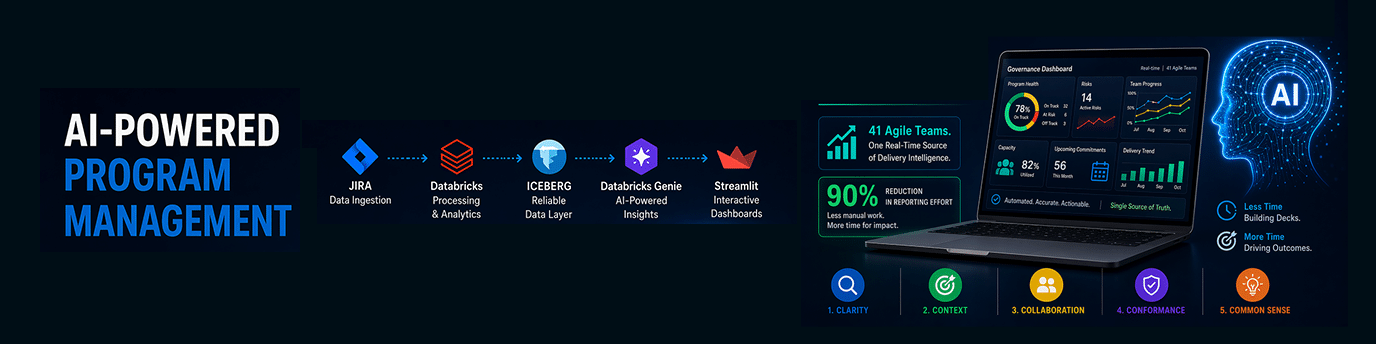
The solution uses Streamlit, Databricks Genie, Iceberg tables, and automated JIRA data ingestion to create a real-time delivery intelligence platform that turns reporting into an on-demand capability.
Bottom line: this shifted governance reporting from a manual, time-consuming exercise to a near real-time decision-support capability.
What made this valuable was not just the automation itself, but what it gave back to the organization: time, focus, transparency, and better decision support. By consolidating delivery data directly from JIRA and systematically calculating program metrics, the platform reduced reporting effort by approximately 90 percent while improving data consistency and trust.
Status reports that once required coordination across dozens of teams can now be generated instantly. Leaders still have flexibility to refine messaging and add context, but the burden of gathering and consolidating metrics has been removed. The result is a single source of truth with near real-time visibility into program health, risks, accomplishments, capacity, and delivery trends across all 41 teams.
As I worked through this journey, I realized the bigger lesson had little to do with the application alone. Building something valuable in an AI-enabled world takes more than the right tools—it takes the right mindset. For me, five principles consistently made the difference: Clarity, Context, Collaboration, Conformance, and Common Sense
1. Clarity
Start with the right requirement. Leaders need the right metrics, teams need the right inputs, and the solution must support action—not just reporting.
2. Context
Data only matters when grounded in real delivery conditions such as progress, risks, capacity, commitments, and planned work.
3. Collaboration
Strong outcomes come from refining prompts, validating results, and combining human judgment with AI support.
4. Conformance
Enterprise solutions must be secure, governed, maintainable, and aligned to standards—not just fast.
5. Common Sense
Judgment is still essential: knowing when to automate, when to validate, and when to challenge the output.
This project reinforced a simple but important idea: modern program management is no longer just about reporting status. It is about building systems that improve visibility, reduce manual effort, strengthen decision-making, and build trust in the data behind every conversation.
In this case, the platform created a transparent, data-driven view of delivery across 41 Agile teams while reducing reporting effort by 90 percent. More importantly, it shifted the focus from collecting information to acting on information.
To me, that is the real promise of AI-powered program management: less time assembling updates, more time driving outcomes.
I would love to hear how others are using AI to improve delivery visibility, governance, and decision-making.