

17 September | 6 min read
Two companies can have similar products, similar talent, and similar budgets; yet one can consistently launch faster than the other. Often, the difference isn’t the people. It’s the systems they work with. Better tools, systems, and infrastructure help teams collaborate, automate processes, and respond faster to change. In a competitive industry, this technology becomes a key competitive advantage, enabling talented people to work smarter and move faster.
Today, cloud adoption has changed the way modern businesses operate, build products, manage data, serve customers, and respond to market changes. With a good strategy, businesses gain the flexibility to experiment, scale, and launch faster. Meanwhile, businesses are still dependent on rigid legacy infrastructure and often spend more time maintaining systems than improving them.
So, is moving to the cloud really connected to faster growth? And if the advantages are so clear, why haven’t all companies made the move?
Until a few years back, cloud adoption was viewed primarily as an IT initiative: moving servers, applications, and databases from physical data centers to cloud platforms. But now the approach has changed. Today, cloud computing influences product development, customer experience, cybersecurity, data analytics, and business operations. Instead of investing in the physical infrastructure upfront, companies can now access computing resources when they need them and scale those resources as demand changes. And this flexibility is one of the key cloud migration benefits for the business.
A business launching a new digital service, for example, can provision the required infrastructure far more quickly than it could with traditional hardware. Development teams can create testing environments, deploy applications, and collaborate across locations without waiting for physical infrastructure to be configured.
The result is a technology environment that can respond to the pace of the business, not the other way around.
Speed has become an important differentiator in almost every industry. Imagine an online retailer preparing for a festival sale. Traffic that normally arrives gradually may spike within minutes. With traditional infrastructure, the company has to provision capacity in advance, often paying for resources that sit idle afterward. A cloud environment allows the business to scale resources around demand and reduce them when the peak is over.
The same principle applies to software development, analytics, customer applications, and internal business systems. Organisations can provision resources when required, experiment with new technologies, and scale successful initiatives without making large infrastructure investments upfront.
This creates a powerful cycle:
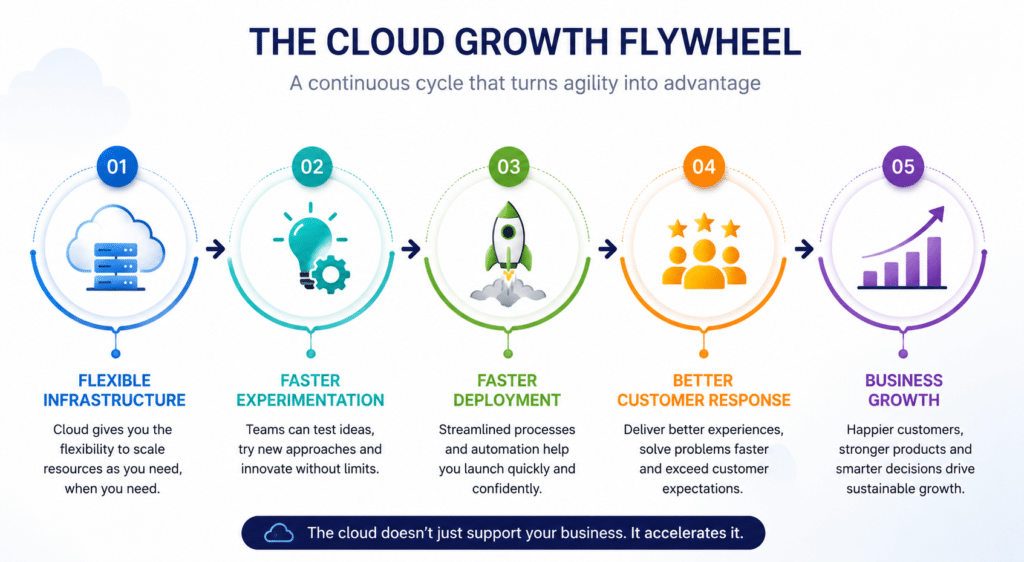
Cloud adoption does not create growth on its own. But it can remove infrastructure-related barriers that slow down growth. The flywheel doesn’t start spinning simply because a company moves workloads to the cloud. It starts when cloud capabilities are connected to faster development, better data access, automation, and smarter decision-making.
Cost savings are often cited as a key reason to move to the cloud, but the business benefits of cloud computing go far beyond reducing infrastructure costs.
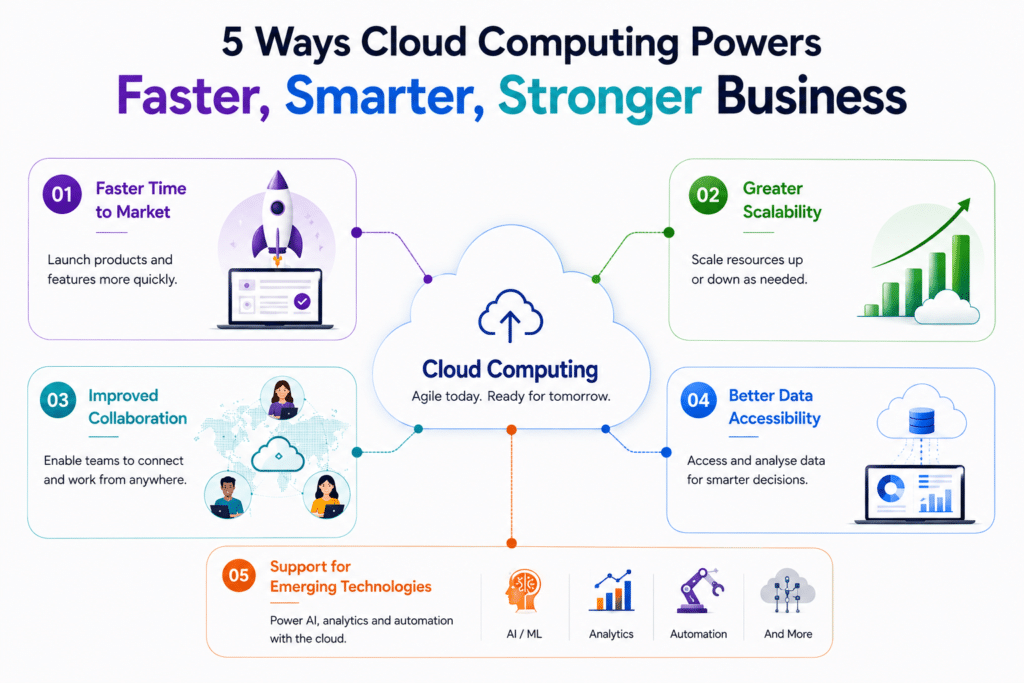
Together, these capabilities allow businesses to become more responsive and adaptable.
If the advantages are significant, why hasn’t every organisation completed its cloud transformation?
However, the difficulty lies in navigating the transition successfully. Many businesses operate applications that were developed years before or even decades ago. These legacy systems may depend on specific hardware, older programming languages, or tightly connected databases. Moving them without proper assessment can introduce operational risks.
Security and compliance are another concern. Organisations handling sensitive customer, financial, or regulated information need strong controls around identity, access, encryption, monitoring, and governance.
Then there is a question about skillsets. Cloud adoption requires emerging skills and careful planning. Without these, organisations may simply recreate existing infrastructure problems in the cloud.
Here are some of the most significant cloud adoption challenges for companies today.
One of the most common misconceptions about cloud adoption is that moving an application to a cloud platform automatically makes it modern.
Well, it does not.
A company can move an inefficient application from an on-premises server to the cloud and still have an inefficient application. A successful cloud transformation requires organisations to examine how their systems work and determine which workloads should be migrated, modernised, replaced or retired.
A practical transformation journey often follows this path:
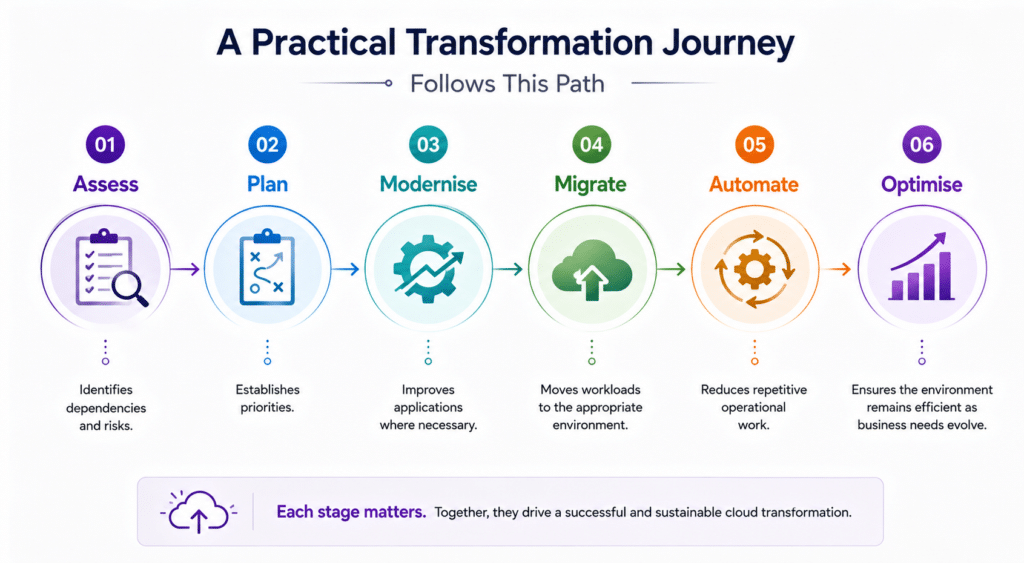
Assessment identifies dependencies and risks, while planning establishes priorities. Modernisation improves applications where necessary. Migration moves workloads to the appropriate environment. Automation reduces repetitive operational work, while continuous optimisation ensures the environment remains efficient as business requirements change.
The strongest cloud initiatives begin with a business objective, not a technology trend.
For example, a company might want to:
Cloud technology can support these objectives, but the architecture should be designed around the outcome the business wants to achieve. This is an important part of understanding why move-to-the-cloud business growth discussions are becoming increasingly common among business leaders.
The conversation is no longer simply about servers and storage. It is about agility, innovation, and the ability to respond to opportunities.
There is no universal rule that companies moving to the cloud will automatically grow three times faster. Business growth depends on far more than infrastructure. Product-market fit, leadership, customer demand, talent, and execution all play critical roles.
The real advantage isn’t the cloud itself. It’s how quickly a business can provision infrastructure, test an idea, release it, measure the result, and scale it when it works.
A business that can launch a new service in weeks instead of months, scale infrastructure when demand increases, provide developers with resources quickly, and turn data into actionable insights has more room to experiment and compete.
That is where the real value of cloud computing lies.
The question for organisations is no longer simply whether they should move to the cloud. The more important question is how they can use cloud technology to become faster, secure, scalable, and adaptable.
The real value of cloud computing isn’t that servers now live somewhere else. It’s that businesses can build, test, scale, and change without waiting for infrastructure to catch up.
Cloud isn’t a shortcut to growth. But when technology, people, and business strategy move together, it can remove one of the biggest constraints on growth: the time it takes to turn an idea into action.