21 October | 7 min read
It may seem like migration to Snowflake means reaching the end of the road. However, once the data is moved to the platform and everything starts running there, it is just the beginning of what can be achieved.
The key question is not only whether the data has been moved. The key question is what the new environment will help you to achieve.
Based on our experience, the true value is in using Snowflake migration for data environment modernization.
A typical enterprise data environment consists of ETL and ELT pipelines, BI dashboards, reports, stored procedures, data quality checks, APIs, applications, access control, monitoring, and third-party integrations.
Just because a table was moved to Snowflake doesn’t mean all related components are automatically moved there. For example, a BI dashboard still relies on a legacy database, a pipeline expects a particular schema, or an application relies on a stored procedure that needs to be redesigned.
The assessment of a Snowflake migration is not only the exercise of assessing source-to-target movement. Teams need to understand the end-to-end data ecosystem and identify what should be migrated, redesigned, consolidated, automated, or retired.
The migration assessment should map the complete flow:
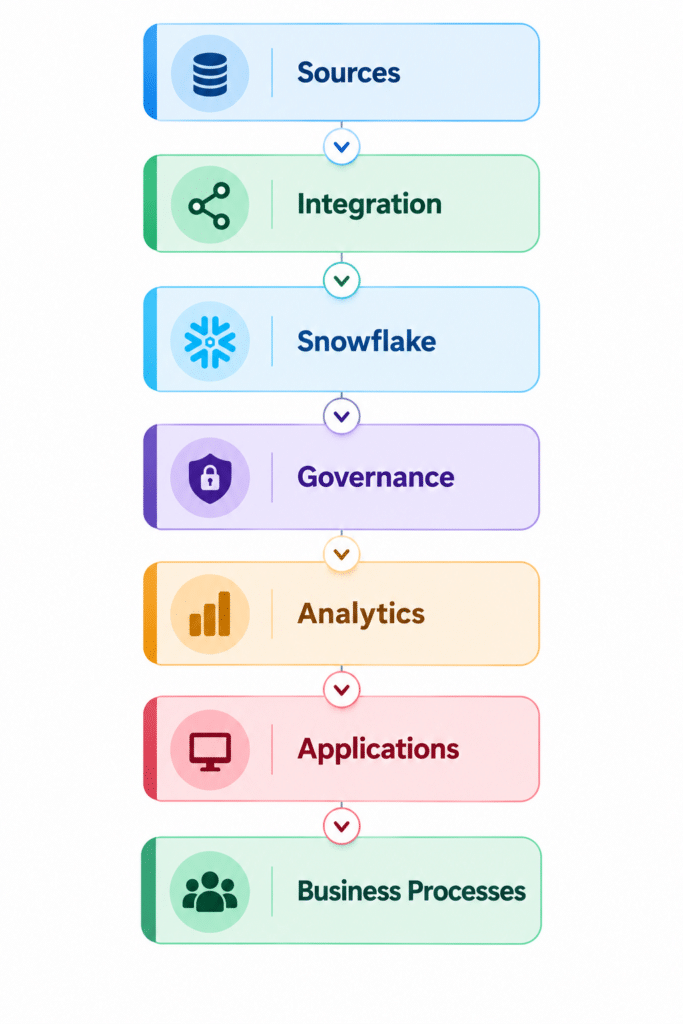
The goal should be to improve the existing environment rather than reproduce its limitations in the cloud.
As enterprise data landscapes evolve, they tend to accumulate databases, ETL solutions, reporting engines, scripts, files, integrations, applications, and point-to-point connections. The cost of the landscape is not confined to its infrastructure alone. Teams invest in:
Instead of asking, How do we migrate this workload to Snowflake? It is useful to ask, How do we build this capability in a modern data landscape? This helps avoid duplicated pipelines, reduces maintenance activities, and releases engineers from the burden of supporting low-value workloads.
We make it our practice to leverage the migration assessment to detect such opportunities early on, and thus make modernization choices ahead of workload migrations.
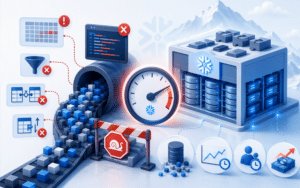
One of the main reasons for migrating to Snowflake is performance, but faster queries do not always translate into reduced costs. The flexibility that comes with the separation of storage and compute requires a clear understanding of how workloads consume compute resources.
Examples of factors that might contribute to increasing costs include the following:
All of these factors make workload optimization and FinOps critical to the success of migration programs.
In practice, we find that migration programs tend to be overly focused on transferring workloads and data validation activities while postponing optimization to the post-migration phase. We believe that much greater success can be achieved by embedding optimization, governance, and business value assessment into the migration plan.
vdgdsMigration can reveal duplication of datasets, ambiguity about ownership, inconsistencies in data definitions, unutilized tables, and misclassified sensitive data.
Clarification is required on issues like: Who owns the data? Who is entitled to access it? Where did it originate from? Which dataset is trustworthy? Is sensitive data classified, tokenized, masked and tagged? How is the sensitive data secured?
“Data governance is about balancing security and accessibility, ensuring that trusted data is easier to find, understand, and reuse.”
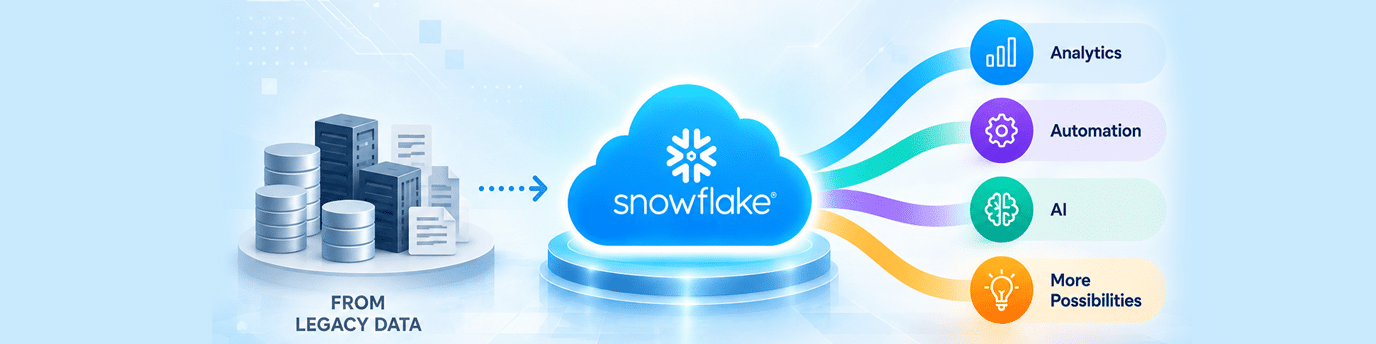
With the cloud-based data ecosystem, data from operational systems, SaaS applications, APIs, and other sources goes into Snowflake via the process of ingestion and transformation. After that, data is stored and managed in such a way that it can also be used by BI tools, analytical functions, applications, and artificial intelligence workloads. In other words, there will be a unified flow from the creation of data to the usage of data rather than keeping separate silos for each application or group.
Instead of creating a copy of the data separately for each group, organizations will have an opportunity to develop their data foundation in a governed and reusable way.
As for the benefits of putting the broader data ecosystem in the cloud, they include the possibility of reducing data silos, simplifying the integration process, reusing data across teams, and using it for analytics, applications, and artificial intelligence from the same data foundation. In addition, it becomes easier to scale the new use cases without having to create data pipelines each time.
For instance: the same trusted customer dataset can be used for building BI dashboards, operational insights and advanced analytics.
After the data environment is modernized, businesses will be able to move on from standard reporting and dashboards. Combining operational, historical, customer and external data will provide valuable insights based on more relevant and timely data.
There is also great potential for automating repetitive tasks like data processing, data quality, monitoring, and reporting. The same environment that will be used for governance and for building a data foundation can then be used for machine learning and AI cases.
The success of any AI project depends on good quality data. Bad quality data, disconnected systems, lack of ownership, and inconsistent business definitions complicate building reliable AI solutions. This is why companies should focus on improving their data foundation before embarking on an AI journey.
With good data available and accessible, it will be much easier to start working on analytics, automation, AI cases, and data products.
The value of moving to Snowflake should not be measured only by comparing legacy infrastructure costs with cloud costs.
ROI can come from several areas:
| Value Area | What can be measured |
| Cost | Infrastructure and platform operating costs |
| Productivity | Engineering or analyst hours saved |
| Data operations | Reduction in manual preparation and maintenance |
| Performance | Reporting and query turnaround time |
| Governance | Time required to find and access trusted data |
| Innovation | New analytics, automation, AI, and data-product use cases |
The value of all of the above lies in their ability to generate business value. Lower cost of infrastructure leaves more budget for other projects, lower amounts of manual work give engineers time to work on something else, and quick access to trusted data will shorten the time that is needed to make business decisions.
For example, automating reporting tasks saves time for the team, while the governed and reusable datasets will reduce the time spent by analysts on data search and reconciliation.
From our perspective, these outcomes should be measured from the start so migration success is tied to business value, not just technical completion.
This creates a broader ROI model:
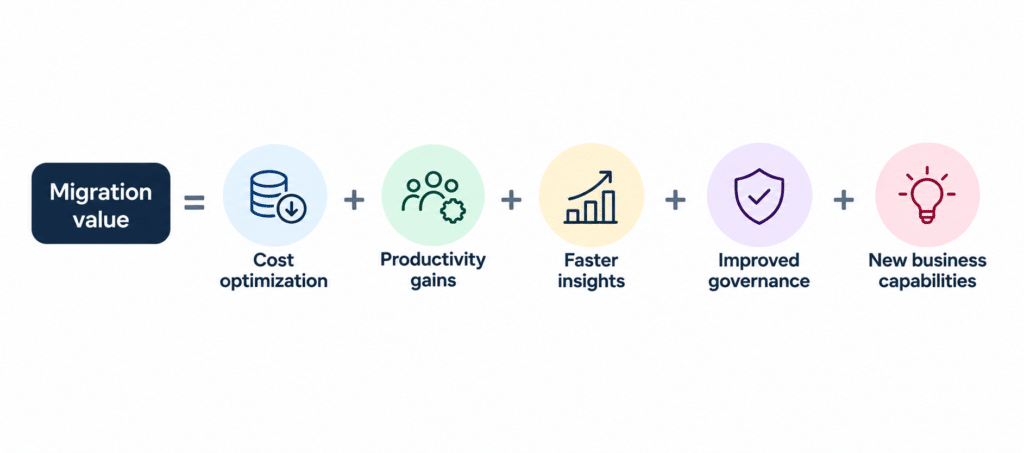
The transition to Snowflake is just one step towards the process of modernization. The true value lies in how companies leverage the new environment to make their analytical processes, automation, AI, and additional capabilities possible.